
YELLOW SPRINGS SENIOR CENTER
November 2023
Dear Aging Person, (that’s all of us!)
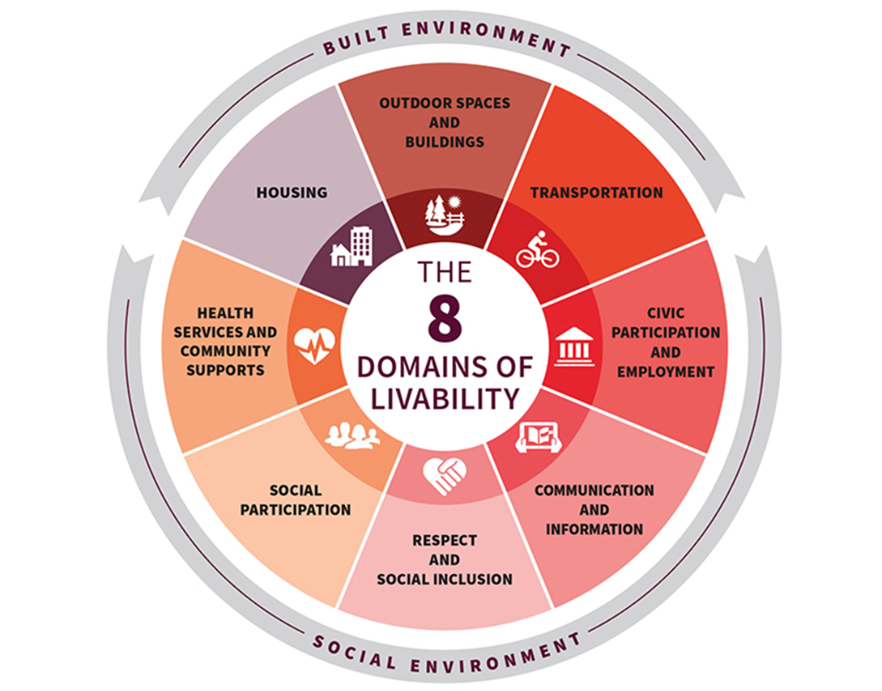
Yellow Springs was one of the earliest communities in Ohio to be recognized as “Age-Friendly”, a credential recognized by AARP. This credential process, completed in 2019, involved a review of the eight domains of livability as shown in this chart.
Dear Aging Person, (that’s all of us!)
Yellow Springs was one of the earliest communities in Ohio to be recognized as “Age-Friendly”, a credential recognized by AARP. This credential process, completed in 2019, involved a review of the eight domains of livability as shown in this chart.
There is a score affiliated with the process; Yellow Springs’ score is 61. (The highest score of any community is 73) We’re above the average, but what does this mean? If you’d like more details, you can see the profile online:
https://livabilityindex.aarp.org/search/Yellow%20Springs,%20Ohio,%20United%20States
Your contribution to the Yellow Springs Senior Center helps the community continue to thrive. The many services of the Center are key aspects of our community’s livability score. These include free transportation; homemaker services at affordable rates; unbiased consultation and assistance with choices of insurance, housing, and financial programs. We work with individuals to support their needs for health care, communication, and as advocates during challenges. Activities, outings, and classes provide social and educational opportunities. Civic engagement is evident as we can brag of over 175 volunteers during this year alone who have provided over 3000 hours of service as class leaders, drivers, receptionists, committee members, board members and a myriad of other ways.
In August, I attended the conference of the Coalition of Age-Friendly Communities of Ohio “CAFCO”. It was a valuable day of networking, inspiration, and learning from experts. A comment during a panel discussion has been ringing in my head ever since – We all want to live the “Good Life”. The question is, what is the Good Life? It can vary from person to person but starts with the most basic elements. Once a person is assured adequate food, shelter, education, and safety, what will enhance life? Is it just the acquisition of material goods that makes life more enjoyable?
My “Good Life”, as I think is true for most people, is made of memories and experiences. Not just the happiest moments or grand events, but also the moments of challenges, rescues, and silliness. My husband loves to tell the story of how I ended up riding a pig backwards. Not my best moment, but definitely memorable. We welcome you to join us at the Senior Center: as a participant, volunteer, or just to drop in and visit with us. We’d love to make some memories with you and help us all keep creating the “Good Life”. I promise that there will be no pig rides involved, but you are welcome to ride in one of our cars and make a new friend.
How can we keep doing all of this great work? An excellent, committed staff; incredible, talented volunteers; the support of the Senior Services Levy through Greene County Council on Aging; and several community grants. Your donation through our Annual Appeal Campaign provides the assurance that we can continue to provide these services and age well along with the community. We will be here for you, in whatever way we can keep making Yellow Springs Age-Friendly and Livable.
Thank you for sharing your enthusiasm and support for all we do at the Center.
https://livabilityindex.aarp.org/search/Yellow%20Springs,%20Ohio,%20United%20States
Your contribution to the Yellow Springs Senior Center helps the community continue to thrive. The many services of the Center are key aspects of our community’s livability score. These include free transportation; homemaker services at affordable rates; unbiased consultation and assistance with choices of insurance, housing, and financial programs. We work with individuals to support their needs for health care, communication, and as advocates during challenges. Activities, outings, and classes provide social and educational opportunities. Civic engagement is evident as we can brag of over 175 volunteers during this year alone who have provided over 3000 hours of service as class leaders, drivers, receptionists, committee members, board members and a myriad of other ways.
In August, I attended the conference of the Coalition of Age-Friendly Communities of Ohio “CAFCO”. It was a valuable day of networking, inspiration, and learning from experts. A comment during a panel discussion has been ringing in my head ever since – We all want to live the “Good Life”. The question is, what is the Good Life? It can vary from person to person but starts with the most basic elements. Once a person is assured adequate food, shelter, education, and safety, what will enhance life? Is it just the acquisition of material goods that makes life more enjoyable?
My “Good Life”, as I think is true for most people, is made of memories and experiences. Not just the happiest moments or grand events, but also the moments of challenges, rescues, and silliness. My husband loves to tell the story of how I ended up riding a pig backwards. Not my best moment, but definitely memorable. We welcome you to join us at the Senior Center: as a participant, volunteer, or just to drop in and visit with us. We’d love to make some memories with you and help us all keep creating the “Good Life”. I promise that there will be no pig rides involved, but you are welcome to ride in one of our cars and make a new friend.
How can we keep doing all of this great work? An excellent, committed staff; incredible, talented volunteers; the support of the Senior Services Levy through Greene County Council on Aging; and several community grants. Your donation through our Annual Appeal Campaign provides the assurance that we can continue to provide these services and age well along with the community. We will be here for you, in whatever way we can keep making Yellow Springs Age-Friendly and Livable.
Thank you for sharing your enthusiasm and support for all we do at the Center.
To use a credit card
- Click on the donate button. Type in the amount you want to donate.
- In the drop down menu, please specify what this donation is for (Fundraising Event, Annual Appeal, Membership, Appreciation, Memorial Gift, Homemaker invoice, or Donation)
- If you'd like to help cover the processing fee that the YSSC pays in order to accept credit cards, select that option.
- Select whether you want to pay with your PayPal account or with a credit card
- If this donation is in Appreciation or a Memorial Gift of someone, or if you want to write a note about your donation, type it in the box that says "Write a note" (credit card option) or "Add a note" (PayPal option)
- Please click the box to share your address and add your contact information so we can acknowledge your gift.
- If you inadvertently send the money without mentioning what it is for, send an email to [email protected] to let us know and we’ll make sure it gets to the correct place.